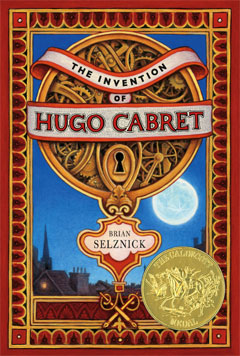
THE INVENTION OF HUGO CABRET by Brian Selznick (Scholastic Press, 2007)
GENRE: Historical
HONORS: Caldecott Medal Winner, National Book Award Finalist, New York Times Best Illustrated Book of 2007, Quill Award, Borders Original Voices Finalist, Publishers Weekly Best Book of 2007
REVIEW:
When twelve-year-old Hugo Cabret’s father dies in a fire at the museum where he worked, Hugo’s uncle takes him to live in the walls of a Paris train station, forcing Hugo to help him tend to the station’s clocks. Hugo’s uncle has a tendency of disappearing for days at a time on alcohol binges, but when days turn into months, Hugo realizes that his uncle may be dead, too. Hugo continues to tend to the clocks to keep the station inspector from noticing his uncle’s absence. Before his death, Hugo’s father introduced him to an automaton he discovered at the museum and, now hiding the automaton in the train station, Hugo needs all the time he can get—and spare parts he can steal—to repair the robot and uncover the mystery behind it. However, when a toymaker and his goddaughter pry into Hugo’s secret life, he risks his biggest secret being exposed.
OPINION:
This is a remarkable book that blends together text, illustration, and movie stills to create a truly unique experience. In keeping with the secret identity of Papa Georges, Selznick brings cinematic techniques to this work with several sequences of illustrations that move closer to focus on a specific element or pan across scenes to give the reader an idea about the overall setting. It is a pleasure for the reader to discover that the allusions to filmmaking are more than just a storytelling technique, but they connect to the narrative itself. Although reluctant readers may be hesitant to read this novel because of the page count, they need only to flip through the pages to see that a large amount of the book is told through illustrations and stills. Also, the mystery of the automaton and its connection to Papa Georges will keep readers glued to the story. With the film version of this novel coming out soon, I cannot wait to see how the story translates onscreen.
IDEAS:
This book could be used for a library display of books that have film adaptations coming out in the near future, as well as a display of Caldecott Medal Winners. It would also make for a fun library program in which teens can read the book and then watch some of the films that are included in it, allowing for discussion about early filmmaking.

No comments:
Post a Comment